Problem
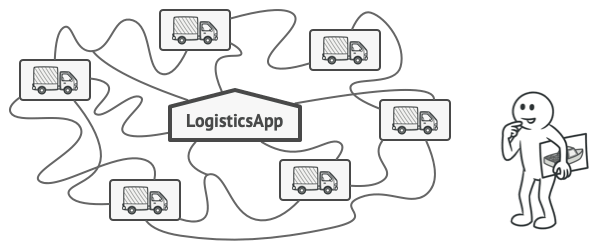
Imagine that you’re creating a logistics management application. The first version of your app can only handle transportation by trucks, so the bulk of your code lives inside the Truck class.
After a while, your app becomes pretty popular. Each day you receive dozens of requests from sea transportation companies to incorporate sea logistics into the app.
Solution
The Factory Method pattern suggests that you replace direct object construction calls (using the new operator) with calls to a special factory method. Don’t worry: the objects are still created via the new operator, but it’s being called from within the factory method. Objects returned by a factory method are often referred to as products.
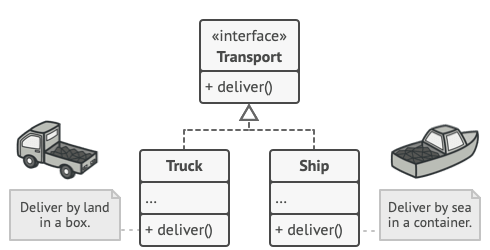
Truck and Ship classes should implement the Transport interface, which declares a method called deliver. Each class implements this method differently: trucks deliver cargo by land, ships deliver cargo by sea. The factory method in the RoadLogistics class returns truck objects, whereas the factory method in the SeaLogistics class returns ships.2)Abstract Factory:
lets you produce families of related objects without specifying their concrete classes.
Problem
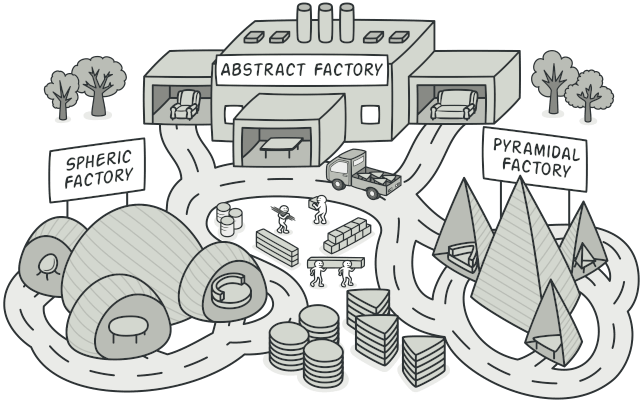
Imagine that you’re creating a furniture shop simulator. Your code consists of classes that represent:
-
A family of related products, say:
Chair+Sofa+CoffeeTable. - Several variants of this family. For example, products
Chair+Sofa+CoffeeTableare available in these variants:Modern,Victorian,ArtDeco.
You need a way to create individual furniture objects so that they match other objects of the same family.
Also, you don’t want to change existing code when adding new products or families of products to the program. Furniture vendors update their catalogs very often, and you wouldn’t want to change the core code each time it happens.
Solution
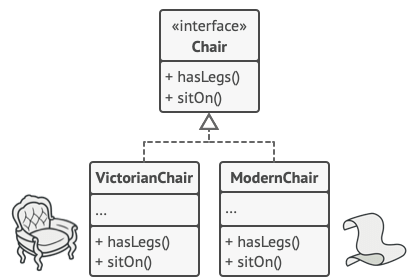
declare interfaces for each distinct product of the product family (e.g., chair, sofa or coffee table). Then you can make all variants of products follow those interfaces.
createChair, createSofa and createCoffeeTable). These methods must return abstract product types represented by the interfaces we extracted previously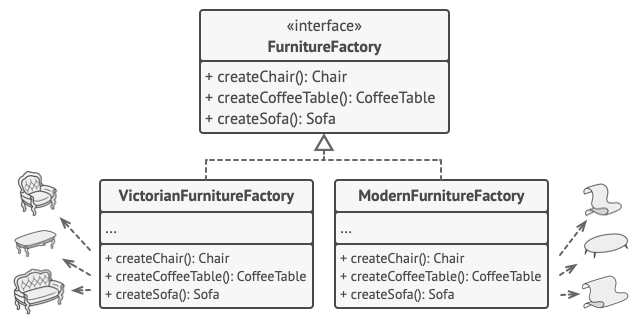 3)Builder:
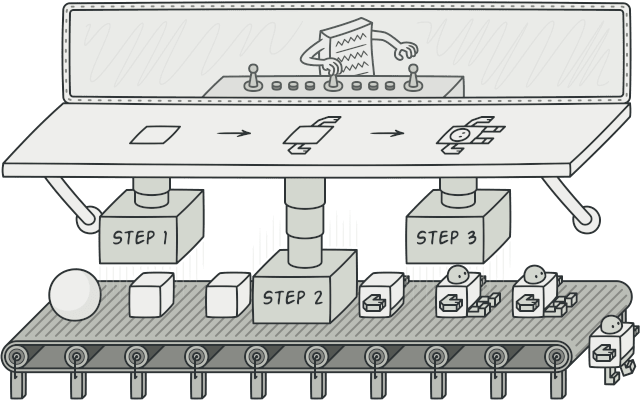
lets you construct complex objects step by step. The pattern allows you to produce different types and representations of an object using the same construction code.
Problem
Imagine a complex object that requires laborious, step-by-step initialization of many fields and nested objects. Such initialization code is usually buried inside a monstrous constructor with lots of parameters. Or even worse: scattered all over the client code.
Solution
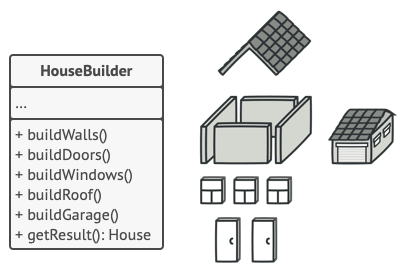
The Builder pattern suggests that you extract the object construction code out of its own class and move it to separate objects called builders.
lets you ensure that a class has only one instance, while providing a global access point to this instance.
Problem
The Singleton pattern solves two problems at the same time, violating the Single Responsibility Principle:
- Ensure that a class has just a single instance. Why would anyone want to control how many instances a class has? The most common reason for this is to control access to some shared resource—for example, a database or a file.
- Provide a global access point to that instance. Remember those global variables that you (all right, me) used to store some essential objects? While they’re very handy, they’re also very unsafe since any code can potentially overwrite the contents of those variables and crash the app.
Solution
All implementations of the Singleton have these two steps in common:
- Make the default constructor private, to prevent other objects from using the
newoperator with the Singleton class. - Create a static creation method that acts as a constructor. Under the hood, this method calls the private constructor to create an object and saves it in a static field. All following calls to this method return the cached object.
5)Adapter:
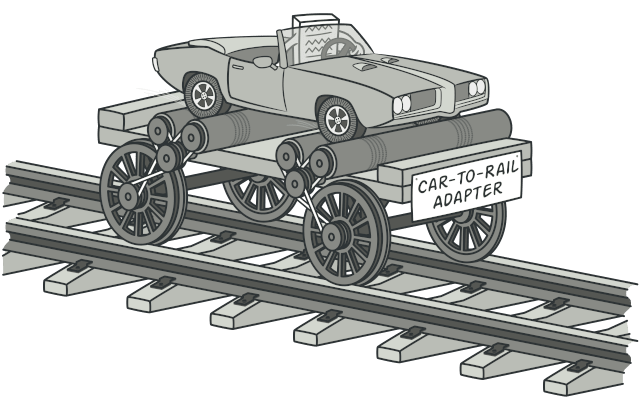
allows objects with incompatible interfaces to collaborate.
Problem
Imagine that you’re creating a stock market monitoring app. The app downloads the stock data from multiple sources in XML format and then displays nice-looking charts and diagrams for the user.
At some point, you decide to improve the app by integrating a smart 3rd-party analytics library. But there’s a catch: the analytics library only works with data in JSON format.
Solution
You can create an adapter. This is a special object that converts the interface of one object so that another object can understand it.
6)Observer:
lets you define a subscription mechanism to notify multiple objects about any events that happen to the object they’re observing.
Problem
Imagine that you have two types of objects: a Customer and a Store. The customer is very interested in a particular brand of product (say, it’s a new model of the iPhone) which should become available in the store very soon.
Solution
The object that has some interesting state is often called subject, but since it’s also going to notify other objects about the changes to its state, we’ll call it publisher. All other objects that want to track changes to the publisher’s state are called subscribers.
The Observer pattern suggests that you add a subscription mechanism to the publisher class so individual objects can subscribe to or unsubscribe from a stream of events coming from that publisher. Fear not! Everything isn’t as complicated as it sounds. In reality, this mechanism consists of 1) an array field for storing a list of references to subscriber objects and 2) several public methods which allow adding subscribers to and removing them from that list.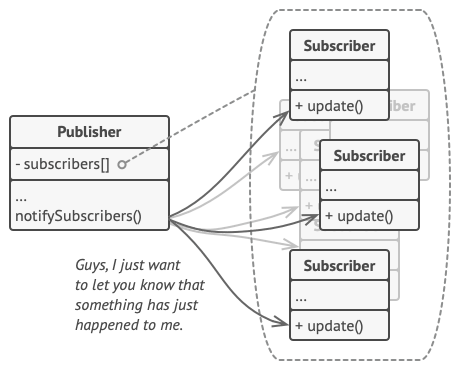
7)State:
lets an object alter its behavior when its internal state changes. It appears as if the object changed its class.
8)Strategy: